
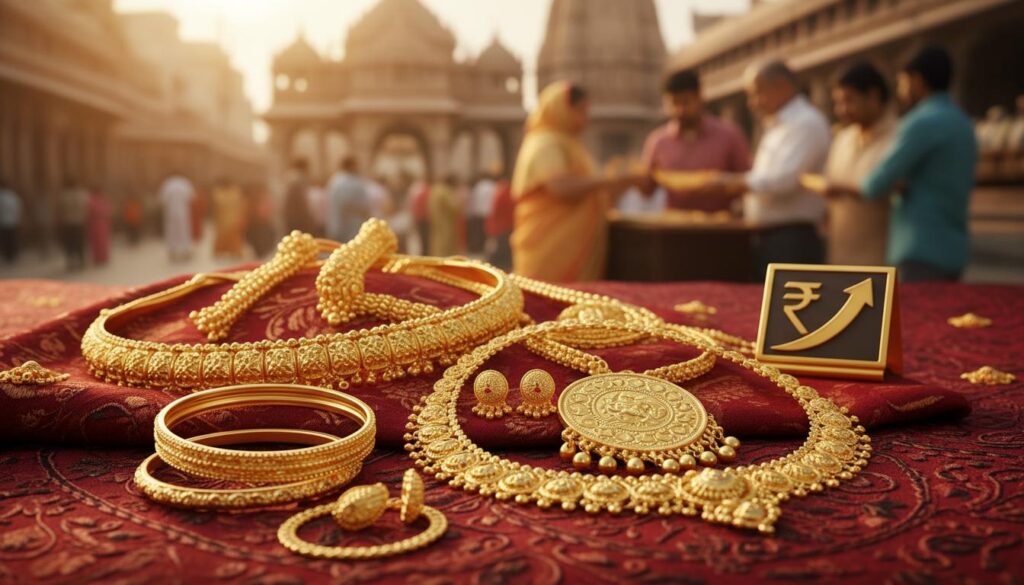
Whether you have family in Mumbai planning a wedding, you collect bullion, or you simply like to benchmark metals across markets, the gold price in India is worth watching from New Zealand. It moves with global spot prices, the rupee, and a web of taxes and premiums unique to India. This guide breaks down how pricing works, the types of gold you’ll see quoted, smart ways to use the data from here in Aotearoa, and the traps to avoid.
What is
The gold price in India is the market rate Indian dealers and jewellers use to quote gold, usually per gram or per 10 grams, in Indian rupees (INR). It’s built from the international spot price (in US dollars), translated into rupees, then adjusted for local import duties, goods and services tax (GST), and dealer premiums. Retail jewellery also includes “making charges” and purity differences (for example 22K vs 24K).
Key points at a glance:
- Quoted units: per gram and per 10 grams; wholesale markets also track per kilogram.
- Purity grades: 24K (999), 22K (916), 18K (750), and 14K (585) are common. 24K is investment-grade bullion; 22K and lower are for jewellery.
- City variation: Prices differ slightly across cities such as Delhi, Mumbai, Chennai, and Kolkata because transport, local demand, and premiums vary.
- Benchmarks: Dealers follow global spot/COMEX/LBMA rates, the rupee–US dollar exchange, and domestic quotes published by industry bodies.
How it works
Think of Indian gold pricing as a ladder. Each rung adds or shifts the final number you see at the counter or on a dealer’s website.
- Global spot price: The base is the international price per troy ounce (31.1035 grams), set by global trading.
- USD/INR exchange rate: A weaker rupee lifts the local price even if global gold is flat; a stronger rupee can cushion global spikes.
- Import duties and cesses: India levies duties on refined gold. The effective load typically totals around 15–16% on imported bullion, which lifts domestic prices over global spot.
- GST: 3% is charged on the transaction value of gold. Jewellery making charges attract additional GST.
- Dealer premium and logistics: Insurance, shipping, financing costs, and margins add a small premium on bars and coins.
- Making charges (jewellery): Labour and design are priced separately, often as a percentage of the gold value or a per-gram fee. Intricate pieces cost more.
- Market forces: Seasonal demand (wedding season, Diwali, Akshaya Tritiya), harvest incomes, and local liquidity can nudge prices up or down.
- Futures and hedging: The Multi Commodity Exchange (MCX) in India lists gold futures in rupees, giving jewellers and importers a way to hedge.
For a New Zealand reader comparing markets, two levers matter most: the rupee exchange rate and India’s import/GST structure. Together, they explain why the gold price in India often sits above a simple USD-to-INR conversion of global spot.
India vs New Zealand: how taxes and premiums shape retail prices
| Component | India (typical) | New Zealand (typical) | Why it matters |
|---|---|---|---|
| Global spot base | Yes (USD → INR) | Yes (USD → NZD) | All pricing starts here. |
| Import duty | Applies to bullion; duties/cesses around 15–16% effective | Generally not applied to qualifying bullion | Key reason India’s base price is higher. |
| GST/VAT on bullion | 3% GST on gold value (plus GST on making charges for jewellery) | Qualifying fine gold (≥99.5% purity) is generally zero-rated for GST | NZ treatment can lower retail bullion costs. |
| Dealer premium | Yes, modest on bars/coins; higher on jewellery | Yes, varies by dealer and product | Reflects fabrication, transport, and margin. |
| Making charges | Common for jewellery; can be substantial | Common for jewellery; bullion none/minimal | Design complexity drives cost. |
Types / examples
When people quote the gold price in India, they often mean one of the following. Each behaves differently at the counter.
- 24K bars and coins (999): Investment-grade bullion. Pricing is closest to the underlying rate plus duties, GST, and a small premium.
- 22K jewellery (916): The most popular jewellery purity. It’s durable enough to wear and still gold-rich. Price includes gold value at 22K, GST, and making charges.
- 18K and 14K jewellery: More alloy, more resilience, more design flexibility. Lower gold content reduces the base cost but making charges still apply.
- Gold ETFs (India): Exchange-traded funds on NSE/BSE track domestic gold prices net of fund fees. Suitable for Indian residents; not a route for most NZ-based investors.
- Sovereign Gold Bonds (SGBs): Government bonds linked to gold’s price, paying fixed interest (historically 2.5% p.a.) in rupees. Subscription is generally limited to Indian residents; not available to new non-resident applicants.
- Digital gold: App-based fractional gold backed by refiners in India. Convenient domestically but KYC and residency rules limit cross-border use.
Karat and use-case snapshot
| Karat | Purity (approx.) | Common form | Why pick it |
|---|---|---|---|
| 24K | 99.9% | Bars, coins | Pure exposure to the gold price; easier to value and resell. |
| 22K | 91.6% | Necklaces, bangles | Traditional Indian jewellery; balance of purity and strength. |
| 18K | 75.0% | Designer jewellery | Harder alloy for intricate designs; lower base metal cost. |
| 14K | 58.5% | Fashion pieces | Cost-effective; wide design palette. |
Pros and cons
Using the Indian gold price as your benchmark from NZ
- Pros:
- Rich market signals: Reflects global moves plus the rupee and local demand.
- Useful for gifting/remittances: Helps you time transfers for weddings or festival purchases.
- Differentiated products: Insight into 22K jewellery trends, which are less common in NZ.
- Cons:
- Higher all-in prices: Import duties and GST lift India’s retail levels over global spot.
- City-by-city noise: Minor differences can confuse quick comparisons.
- Limited access to India-only products: SGBs and some ETFs aren’t open to non-residents.
Buying jewellery in India vs buying bullion in New Zealand
- Buying jewellery in India can deliver exceptional craftsmanship, but making charges can exceed the metal value difference you think you’re saving. Always check the BIS hallmark and itemised billing.
- Buying fine bullion in New Zealand benefits from zero-rated GST on qualifying products and straightforward resale, though premiums vary by dealer and product size.
- If you plan to bring jewellery back to New Zealand, check border rules. You may need to declare high-value items, and taxes or charges can apply.
How to use or choose
How to check today’s gold price in India from New Zealand
- Note the global spot price per troy ounce in USD.
- Convert to rupees using the current USD/INR rate.
- Add India’s typical duty load (around 15–16% on imported bullion) to estimate the domestic base for 24K.
- Account for 3% GST on the gold value.
- Layer on a reasonable dealer premium (small for bars/coins) or making charges (higher for jewellery).
- For 22K or lower purities, multiply the pure gold value by the purity ratio (e.g., 0.916 for 22K) before adding GST and charges.
- Cross-check with reputable Indian dealer quotes or industry bodies to fine-tune your estimate.
Choosing what to buy, and where
- For investment:
- Prefer 24K bars or coins with clear purity stamps and certificates from recognised refiners.
- In NZ, buy from established bullion dealers with transparent buy-back policies and tight spreads.
- In India, ask for an itemised invoice showing weight, purity, GST, and premium.
- For jewellery:
- Check BIS hallmarking with the HUID (unique ID). It’s your first safeguard on purity.
- Compare making charges across stores. A lower gold rate can be offset by higher labour fees.
- Confirm buy-back or exchange terms, especially for 22K pieces purchased during peak season.
- For currency-aware buyers:
- Watch both USD/INR and USD/NZD. A weak rupee can lift Indian prices even if NZD gold is steady.
- If you’re funding a purchase in India, compare the timing of your NZD-to-INR transfer to minimise slippage.
FAQ
Why does the gold price in India differ by city?
Transport, local demand, and dealer competition move premiums a little. Taxes are national, but logistics and margins aren’t. That’s why Mumbai may quote slightly differently to Chennai or Kolkata on the same day.
What’s the quickest way to convert per gram to per ounce?
One troy ounce is 31.1035 grams. Multiply the per-gram price by 31.1035 to get an ounce. To go the other way, divide by 31.1035. If you’re comparing 22K jewellery, multiply the pure-gold equivalent by 0.916 before adding charges and GST.
Do seasonal events really move prices in India?
They can move premiums and short-term demand. Wedding seasons, Diwali, and Akshaya Tritiya often bring busy showrooms and firmer retail quotes, even if global spot is calm.
How do import duties affect the final number?
Duties and cesses on refined gold typically add roughly 15–16% to the import cost, before GST and dealer margins. This is the main gap between global spot and the base Indian rate for 24K bullion.
Is Indian GST refundable to tourists on jewellery?
India does not broadly operate a tourist GST refund scheme for jewellery purchases. Assume the 3% GST is payable and will remain part of your cost.
Can New Zealand residents buy Sovereign Gold Bonds?
New subscriptions are generally limited to Indian residents and certain domestic entities. If a holder later becomes non-resident, they may continue to hold, but new purchases are restricted.
What about purity assurance?
Look for BIS hallmarking with the HUID on jewellery in India. For bars and coins, prefer well-known refiners with assay certificates. In NZ, choose LBMA-accredited or widely recognised brands for easier resale.
Will a falling rupee push the gold price in India higher?
Usually yes. If the rupee weakens against the dollar, the INR price of dollar-denominated gold tends to rise, even without a move in global spot.
Why is 22K so common in India but not in NZ?
Indian jewellery traditions favour high-purity wearable gold, hence 22K. In New Zealand, 18K and 14K are more common for daily wear because they’re harder alloys and better for intricate settings.
Is it cheaper to buy gold in India or New Zealand?
For pure bullion, New Zealand can be more cost-efficient because qualifying fine gold is generally zero-rated for GST and there’s no equivalent of India’s import duty load. For jewellery, India offers vast choice, but making charges and taxes often outweigh any perceived base-price advantage.
Final take
If you’re in New Zealand and you track the gold price in India, keep three levers in view: the global spot price, the rupee, and India’s tax structure. From there, the rest is product-specific: purity, premiums, and making charges. Use the steps above to sanity-check any quote you see, and pick the channel—Indian jewellery, Indian bullion, or NZ bullion—that fits your purpose and your borders.