
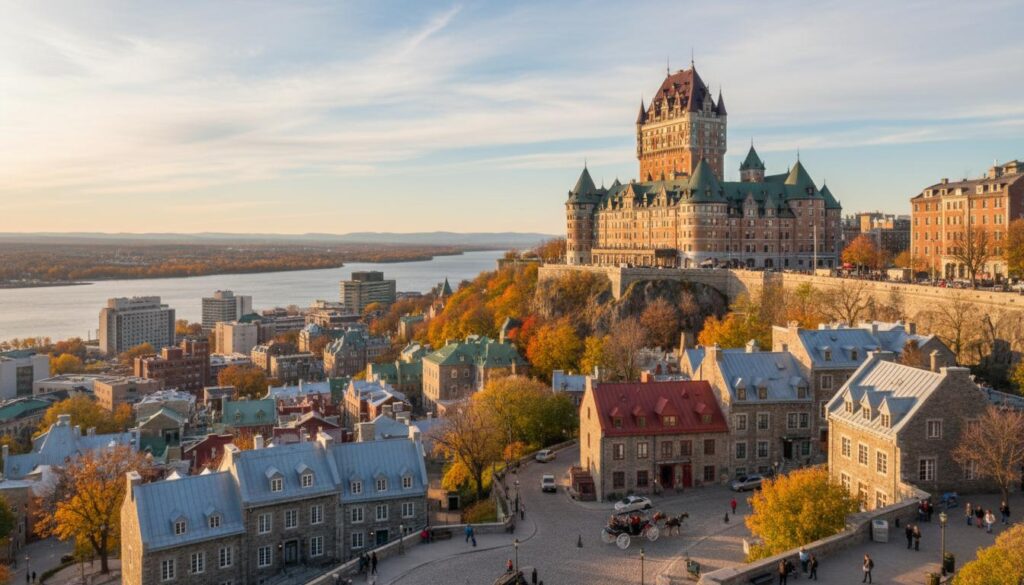
Quebec City feels like Europe without the long-haul to Paris. Cobblestones. Stone walls. A castle-like hotel on a bluff above the St. Lawrence River. For travellers from Aotearoa, it’s a rewarding detour that pairs history with easy day trips and great food. This guide explains what quebec city is known for, how the city works for visitors, when to go, where to stay, and how to plan a smooth trip from New Zealand.
What is
Quebec City (often written Québec City) is the capital of the province of Quebec in Canada. Founded in 1608 by Samuel de Champlain, it’s one of North America’s oldest European settlements and the only fortified city north of Mexico. Its historic centre, Old Quebec (Vieux-Québec), is a UNESCO World Heritage Site, packed with 17th–19th century architecture, narrow lanes, and lookout points over the river.
The city sits on the north shore of the St. Lawrence River, about 250 km northeast of Montreal. It’s compact and walkable, with two distinct levels: Upper Town (Haute-Ville) around the Château Frontenac and Citadelle, and Lower Town (Basse-Ville) around Petit-Champlain and the old port. A funicular links the two.
Quebec City is majority French-speaking. English is widely used in tourism and hospitality, but you’ll hear French everywhere. A few polite words—bonjour, merci, s’il vous plaît—go a long way.
Good to know for Kiwis:
- Entry: New Zealand citizens don’t need a visa for short visits to Canada, but you must get an eTA (Electronic Travel Authorization) if arriving by air.
- Money: Canadian dollars (CAD). Cards are widely accepted. Expect sales tax to be added at checkout.
- Time zones: Quebec City is in Eastern Time (UTC−5 standard, UTC−4 summer). The time difference from NZ is usually 16–18 hours.
- Seasonality: Four true seasons—snowy winters, warm summers, brilliant autumn colour.
How it works
Getting there from NZ is via North American or Canadian hubs. Common routes go Auckland–Vancouver–Quebec City, or via Los Angeles and Montreal with a quick onward flight or train. Direct long-hauls land you in Canada with a single connection to YQB (Jean Lesage International Airport).
On the ground, the historic core is best on foot. Streets are steep in places and can be icy in winter, but distances are short and views are constant. Taxis and ride-hailing apps operate. The RTC bus network is reliable; the frequent Métrobus lines (such as 800-series routes) cover key corridors. Between Upper and Lower Town, use the funicular or the Breakneck Stairs if you fancy a climb.
Seasonal rhythm matters. Summers bring patios and music festivals; autumn offers leaf-peeping and harvest trips to Île d’Orléans; winter delivers the Quebec Winter Carnival, ice skating, and snowy day trips to nearby ski fields. Spring is maple season—sugar shacks serve hearty meals and fresh maple taffy on snow.
Costs are mid-range for North America. Accommodation in Old Quebec commands a premium during holidays and festivals. Tipping is standard (15–20% in restaurants, a dollar or two per drink at bars, 10–15% for taxis). Prices are quoted before tax; the combined GST and Quebec sales tax adds roughly 15% to most purchases.
Types / examples
Historic highlights
- Old Quebec (Upper and Lower Town): Fortified walls, stone gates, and lively squares.
- Château Frontenac: The city’s postcard landmark, with a panoramic terrace.
- Citadelle and Plains of Abraham: Military history and a vast urban park where a pivotal 1759 battle took place.
Nature and viewpoints
- Montmorency Falls: 83 metres high—taller than Niagara—accessible by bus or car.
- Île d’Orléans: Island farms, cideries, and country lanes 20–30 minutes from town.
- Promenade Samuel-De Champlain: Riverside walking and cycling paths.
Food and drink
- Poutine, tourtière, duck confit, and maple desserts.
- Microbreweries in Saint-Roch, classic bistros in Old Quebec, and refined dining around Grande Allée.
- Markets like Marché du Vieux-Port (seasonal operations) for local produce, cheeses, and syrups.
Neighbourhoods to explore
- Petit-Champlain: Boutiques and café terraces under the bluff.
- Saint-Jean-Baptiste: Independent shops and bakeries along Rue Saint-Jean.
- Saint-Roch: Creative quarter with bars, roasteries, and tech startups.
- Montcalm: Museums and leafy streets near the Plains of Abraham.
Day trips and winter sports
- Stoneham and Mont-Sainte-Anne: Alpine skiing and snowboarding within an hour’s drive.
- Parc National de la Jacques-Cartier: Hiking, canoeing, and snowshoeing in a dramatic glacial valley.
- Charlevoix region: Scenery, whale-watching excursions (in season), and farm-to-table dining.
| For NZ travellers | Quebec City | Montreal |
|---|---|---|
| Vibe | Historic, compact, storybook streets | Cosmopolitan, larger, diverse neighbourhoods |
| Language feel | More French-forward; English common in tourism | French and English widely mixed |
| Walkability | Excellent in Old Quebec; hills and stairs | Good, but distances are greater |
| Winter experience | Classic snow city, Carnival, nearby ski fields | Urban winter with strong arts scene |
| Time needed | 2–3 days for highlights | 3–4 days for a good overview |
| Standout icon | Château Frontenac and city walls | Mount Royal and the St. Lawrence waterfront |
Pros and cons
- Pros:
- UNESCO-listed Old Quebec with sights in easy walking range.
- Distinct French-Canadian culture and cuisine.
- Four-season appeal: festivals in summer, snow fun in winter.
- Safe, clean, and family-friendly.
- Cons:
- Winter is cold and icy; gear and care required.
- English may be limited in smaller shops outside the core.
- Steep streets can be tough with luggage or prams.
- Peak-season prices in Old Quebec.
How to use or choose
Step-by-step trip plan for New Zealanders
- Pick your season. For mild weather, aim for late May to early October. For snow and Carnival, late January to February.
- Book flights with smart connections. Look for Auckland–Vancouver–Quebec City, or connect via Los Angeles and Montreal, then a short hop or VIA Rail train.
- Apply for your eTA online before you fly. It’s linked to your passport and usually approved quickly.
- Choose your base. First-time visitors should stay inside Old Quebec or just outside the walls for easy walks to major sights.
- Sketch a 2–3 day plan. Day 1: Upper Town and the terrace. Day 2: Lower Town and Montmorency Falls. Day 3: Île d’Orléans or museums.
- Pre-book popular experiences in peak periods. Think guided Old Quebec walks, the funicular on holiday weekends, and special events.
- Pack for the real weather. Summer can be hot and humid; winter demands proper boots, gloves, and layers.
- Sort payments and comms. Bring a fee-free card, enable eSIM or buy a local SIM, and expect contactless tap to work almost everywhere.
Where to stay: quick picks
- Old Quebec (inside the walls): Best for first-timers and short stays; classic charm, higher rates.
- Petit-Champlain / Old Port: Romantic, atmospheric, close to restaurants; expect stairs or funicular rides.
- Saint-Roch: Trendy, better value, great for food and nightlife; 15–20 minutes’ walk to Old Quebec uphill.
- Montcalm: Quiet, near museums and the Plains of Abraham; good for families.
Packing tips by season
- Summer (Jun–Aug): Light clothing, sunhat, breathable walking shoes, light rain jacket.
- Autumn (Sep–Oct): Layers, warm jumper, waterproof jacket; temperatures swing.
- Winter (Dec–Mar): Insulated boots with good grip, thermal base layers, down jacket, toque/beanie, scarf, gloves, ice cleats if you plan lots of walking.
- Spring (Apr–May): Waterproof footwear, layers, compact umbrella; thaw can be slushy.
FAQ
Do New Zealand citizens need a visa for Quebec City?
No visa for short tourism stays, but you must obtain an eTA (Electronic Travel Authorization) if you arrive by air. Keep your passport valid for the whole trip.
How many days should I spend in quebec city?
Two full days cover the highlights. Three days allow a day trip to Montmorency Falls or Île d’Orléans. Add more if you plan winter sports or multiple museums.
When is the best time to visit?
For warmth and festivals: late June to early September. For foliage: late September to mid-October. For snow and the Winter Carnival: late January to February. Spring (April–May) is quieter but can be wet and cool.
Is English enough?
Yes for visitors. Staff in hotels, restaurants, and attractions usually speak English. Learn a few French basics for friendliness and easier interactions in local spots.
How cold does it get in winter?
Daytime temperatures often sit between −12°C and −3°C in January–February, with colder snaps. Dress in proper winter layers and insulated boots with grip.
What’s the best way to get around?
Walk within Old Quebec, use the funicular between Upper and Lower Town, and take RTC buses for farther trips. Taxis and ride-hailing are available. Parking inside the walls is limited; consider staying car-free.
How do I get from Montreal to Quebec City?
By car it’s roughly 3 hours. VIA Rail trains take about 3–3.5 hours and drop you near the old port. Intercity buses run similar times. Flights are short but rarely faster door-to-door.
What are the taxes and tipping rules?
Expect about 15% sales tax added at checkout. Tip 15–20% in sit-down restaurants, 10–15% for taxis, and round up at cafés if table service is provided.
Is the tap water safe?
Yes. Tap water is safe and good-tasting.
Can I use my NZ electronics?
Canada uses 120V with Type A/B plugs. Bring a plug adaptor and check if your devices handle 110–120V. Many phone and laptop chargers are dual-voltage.
Are there ski fields near quebec city?
Yes. Stoneham and Mont-Sainte-Anne are within about an hour, with runs for beginners to advanced riders. Snowshoeing and cross-country trails are also close by.
What foods should I try?
Classic poutine, maple taffy, tourtière, local cheeses, and apple or berry products from Île d’Orléans. For a splurge, book a dining room with river views.
Is quebec city family-friendly?
Very. Short walking distances, open spaces like the Plains of Abraham, and plenty of casual eateries make it easy with kids. In winter, sledding hills and skating rinks add fun.
Do I need cash?
Cards are accepted almost everywhere, including contactless. Carry a little cash (CAD) for markets, small cafés, or tips where card isn’t practical.
What about safety?
Quebec City has a low crime rate. Use normal urban precautions, watch for ice in winter, and mind traffic on narrow streets.
Whether you’re chasing snow, stone walls, or maple sweets, quebec city rewards the long flight with a city experience you won’t find anywhere else in North America. Plan a few days, keep your itinerary light, and let the streets lead you—up the stairs, over the walls, and into a lively slice of French Canada that feels both far away and welcoming.